
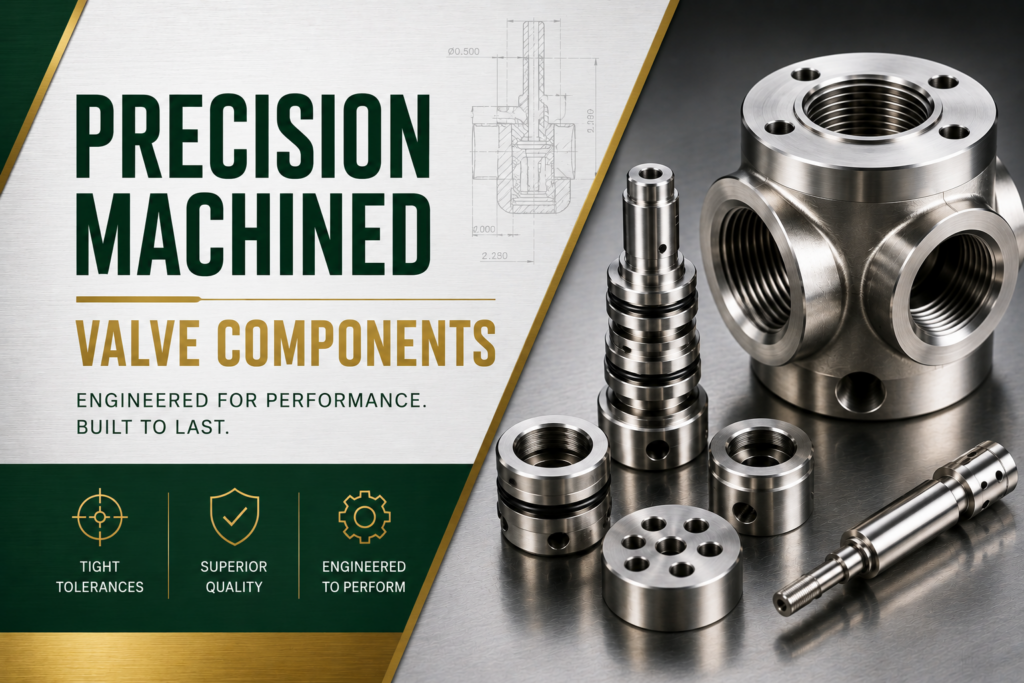
Open up almost any hydraulic, pneumatic, or fluid control valve and you’ll find the same thing: a collection of small, tightly toleranced, turned metal parts doing the real work. The body. The poppet or ball. The seat. The spring retainer. The end cap. In valve after valve, across aerospace, defense, and industrial fluid systems, the anatomy repeats — and so does the manufacturing method. These are Swiss CNC turned parts, and building them complete, to print, at volume, is what we do every day at Fairchild Precision Parts.
This guide walks through the turned components we machine most often for valve and fluid control assemblies, the industries that rely on them, and why engineers and procurement teams building mission-critical valve programs use Fairchild as their turned-parts supplier.
Why Valve Components Are a Natural Fit for Swiss CNC Turning
Valves are, at their core, an assembly of small-diameter, concentric, tightly toleranced turned parts. That’s exactly the geometry Swiss-type CNC lathes were built for. Our Swiss lathes handle parts up to 32mm (1.25″) in diameter and hold tolerances as tight as ±0.0002″, with guided-bushing support that keeps long, slender features — stems, plungers, needle valve tips — from deflecting during the cut. That combination of small diameter and sub-thousandth tolerance is precisely what separates a valve that seals reliably for 20 years from one that leaks under pressure cycling.
We run these parts in materials chosen for the service condition: brass and stainless steel for general fluid control, 316 stainless and Hastelloy for corrosive or high-pressure media, Inconel and titanium for aerospace and cryogenic service, and Delrin or PEEK where a non-metallic seat or insulating component is required. Production volumes range from prototype and first-article runs into the tens of thousands of pieces under a blanket order, without a loss of tolerance control from the first part to the last.
The Turned Components Behind Every Valve
Rather than think about valves as single parts, it helps to think about them as kits of turned components. Here’s the portfolio we machine complete, most in-house from bar stock to finished, inspected part.
Poppets and Seats
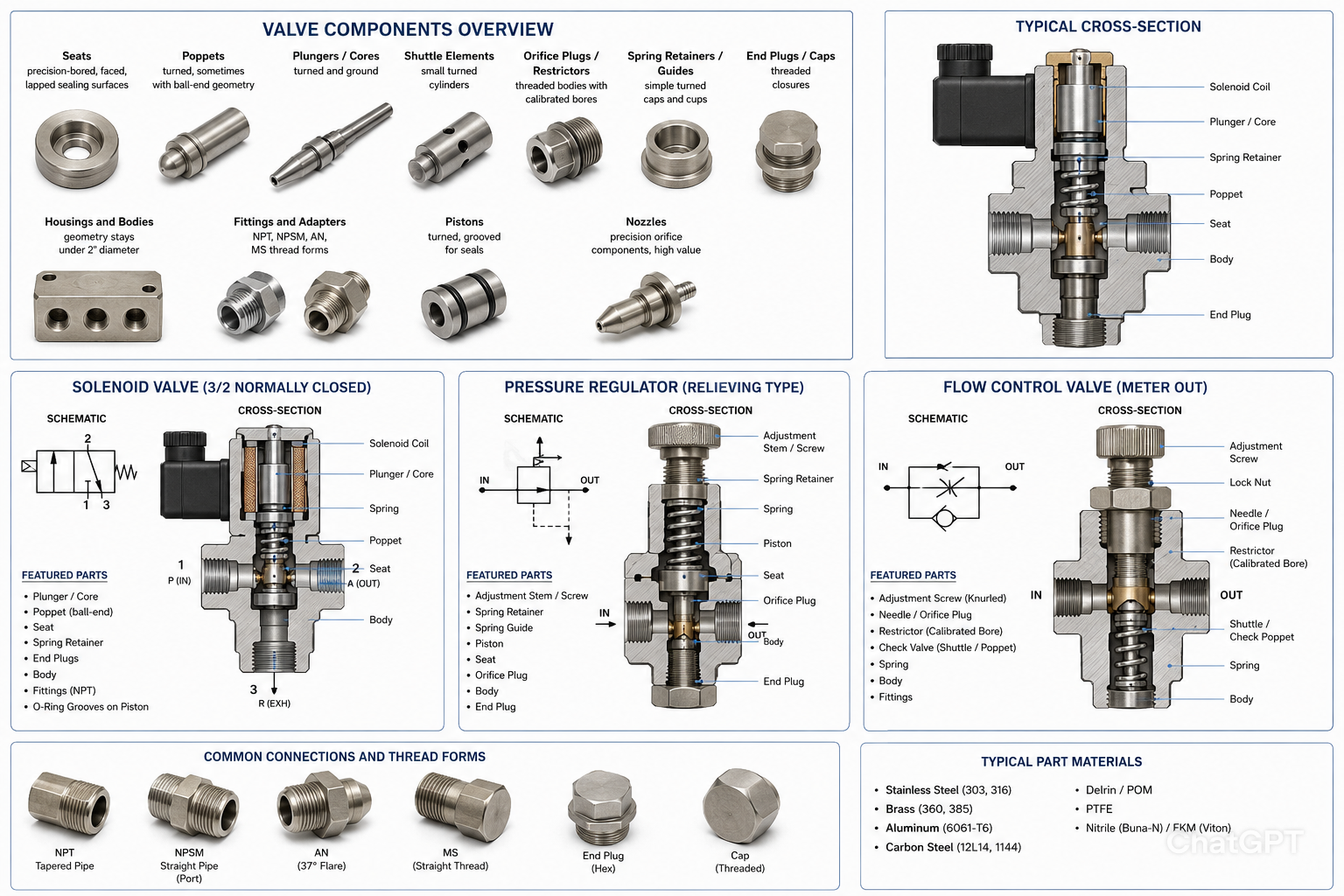
Poppets and their mating seats are the sealing heart of check valves, poppet valves, solenoid valves, and relief valves. A poppet is turned to a precise sealing geometry — flat, conical, or ball-ended — and the seat is bored, faced, and often lapped to match it. Because the seal quality of the entire valve depends on how well these two surfaces mate, we hold tight roundness, concentricity, and surface finish callouts on both. Poppets and seats show up in nearly every fluid control and pneumatic valve line we run, and they’re some of the highest-volume, highest-repeat parts in our shop.
Shuttle Elements
Shuttle valves are essentially built entirely from turned parts — body, shuttle element, dual seats, end plugs, and port fittings. The shuttle element itself is a small, precisely ground turned cylinder that has to move freely but seal tightly at each end of its travel. This is a part type where Swiss turning’s combination of tight OD control and short cycle time really pays off, and it’s why shuttle valve components for aerospace hydraulic and pneumatic systems are one of our primary product lines.
Orifice Plugs and Restrictors
An orifice plug or restrictor is deceptively simple — a threaded body with a calibrated bore — but the calibration is everything. Flow rate through the valve depends on holding that bore diameter within a few ten-thousandths, run after run, so the part performs identically whether it’s the first piece off the machine or the ten-thousandth. It’s one of the purest expressions of what a Swiss lathe does well, and it’s a part type we produce in high volume for aerospace fluid control programs.
Plungers, Cores, and Pistons
Plungers and cores are the turned and ground internals of direct-acting and pilot-operated solenoid valves, while pistons carry seal grooves for pilot-operated valves, cartridge valves, and small hydraulic actuators. Both require a fine ground finish on the OD to protect seal life and a straightness callout that keeps the part from binding in its bore. We machine these to final ground dimension so the assembly seals correctly the first time, without rework on the customer’s line.
Nozzles
Nozzles — the precision orifice components used in safety and relief valves — are among the highest-value parts in the valve portfolio. They combine a precision-bored flow path with tight external geometry, and because they govern the pressure at which a relief valve actually relieves, the tolerance stack has real safety consequences. We treat nozzle work with the same discipline as our aerospace flight-critical components, because in practice, that’s exactly what it is.
Spring Retainers, Guides, End Plugs, and Caps
Every valve needs somewhere for the spring to seat and something to close the body once the internals are assembled. Spring retainers, guides, end plugs, and caps are simple turned cups and threaded closures — straightforward geometry, but still held to the same dimensional and finish standards as the rest of the assembly, since a loose-fitting cap or an out-of-square retainer can throw off spring preload and change the valve’s crack pressure.
Adjustment Stems and Screws
Metering valves, needle valves, and adjustable relief valves rely on a threaded, often knurled adjustment stem to set flow or pressure. These parts combine thread precision with a smooth, consistent feel for the end user turning the adjustment — a detail that’s easy to overlook on a drawing but obvious the moment a technician’s hand is on the knob.
Housings and Bodies
For valve bodies and housings under 2″ in diameter, we machine the part complete — precision bores, cross-drilled ports, and threaded connections in one setup wherever the geometry allows. Keeping the body in-house alongside the internals means we can hold the fit between body and internals ourselves, rather than relying on two vendors’ tolerance stacks to agree.
Fittings and Adapters
Valves don’t exist in isolation — they connect into a system. We machine the NPT, NPSM, AN, and MS thread-form fittings and adapters that tie valve components into the rest of a hydraulic, pneumatic, or fluid control circuit, holding thread class and sealing-surface finish to the same standard as the valve itself.
The Industries These Parts Serve
Because valve components are used everywhere pressurized fluid or gas needs to be controlled, directed, or metered, the parts above show up across a wide range of industries:
- Aerospace — hydraulic and pneumatic shuttle valves, check valves, and relief valve nozzles for flight-critical and ground support systems
- Defense — fluid control components for military hydraulic and pneumatic platforms, often in exotic alloys for extreme service conditions
- Fluid control and hydraulics — cartridge valves, pressure regulators, and flow control valves for industrial hydraulic circuits
- Instrumentation and process control — metering valves, miniature ball valves, and needle valves where tenths-of-a-thousandth accuracy affects measurement integrity
- Industrial equipment — solenoid and pneumatic valve components for automation, packaging, and process machinery
Many of our Tier 2 customers in these markets build the finished valve assembly and come to us for the turned components — which is exactly the kind of long-term, blanket-order production relationship we’re built around.
Why Engineers and Procurement Teams Choose Fairchild for Valve Component Machining
Valve programs are rarely one-off buys. Once a valve is qualified, the components inside it typically need to be reproducible for the life of the program — sometimes decades. That reliability is where Fairchild adds the most value:
- AS9100D and ISO 9001:2015 certified, with the process controls and documentation that aerospace and defense valve programs require
- Swiss CNC turning to ±0.0002″ on parts up to 1.25″ diameter, holding the sealing and fit tolerances valve components demand
- Material range covering brass, stainless steel, tool steel, Inconel, titanium, and engineering plastics like Delrin and PEEK
- Production scale from prototype through tens of thousands of pieces, with blanket order programs and flexible release schedules
- A strong on-time delivery track record, so your valve assembly line isn’t waiting on a turned-parts bottleneck
We also machine complete wherever the part allows — turning, secondary operations, and inspection under one roof — so you’re not managing tolerance stack-up across multiple vendors for a single valve assembly.
Frequently Asked Questions
What valve components can be machined on a Swiss CNC lathe?
Nearly every turned internal of a valve can be produced on a Swiss lathe, including poppets, seats, shuttle elements, plungers, pistons, orifice plugs and restrictors, spring retainers, end caps, adjustment stems, nozzles, and valve bodies and housings under about 2″ in diameter.
What tolerances are typical for valve components?
Sealing surfaces, calibrated orifices, and OD-to-bore fits on valve internals commonly require tolerances in the ±0.0002″ to ±0.0005″ range. Fairchild’s Swiss CNC turning is built specifically to hold this level of precision at production volume.
What materials are used for aerospace and hydraulic valve components?
Common choices include brass and 316 stainless steel for general fluid control, Inconel, Hastelloy, and titanium for high-pressure, corrosive, or cryogenic service, and Delrin or PEEK for non-metallic seats and inserts.
Does Fairchild machine complete valve assemblies or just individual components?
Fairchild machines the turned components — bodies, poppets, seats, pistons, fittings, and related parts — to print and to finished, inspected condition. Customers handle final valve assembly, though we can produce every turned component that goes into it.
Build Your Next Valve Program on a Reliable Turned-Parts Partner
If your valve, hydraulic, or fluid control program depends on tight-tolerance turned components delivered consistently, on schedule, run after run, we’d like to be your Swiss CNC partner. Reach out to the Fairchild Precision Parts team to discuss your drawings, materials, and volumes, and request a quote to see how we can support your program for the long term.