
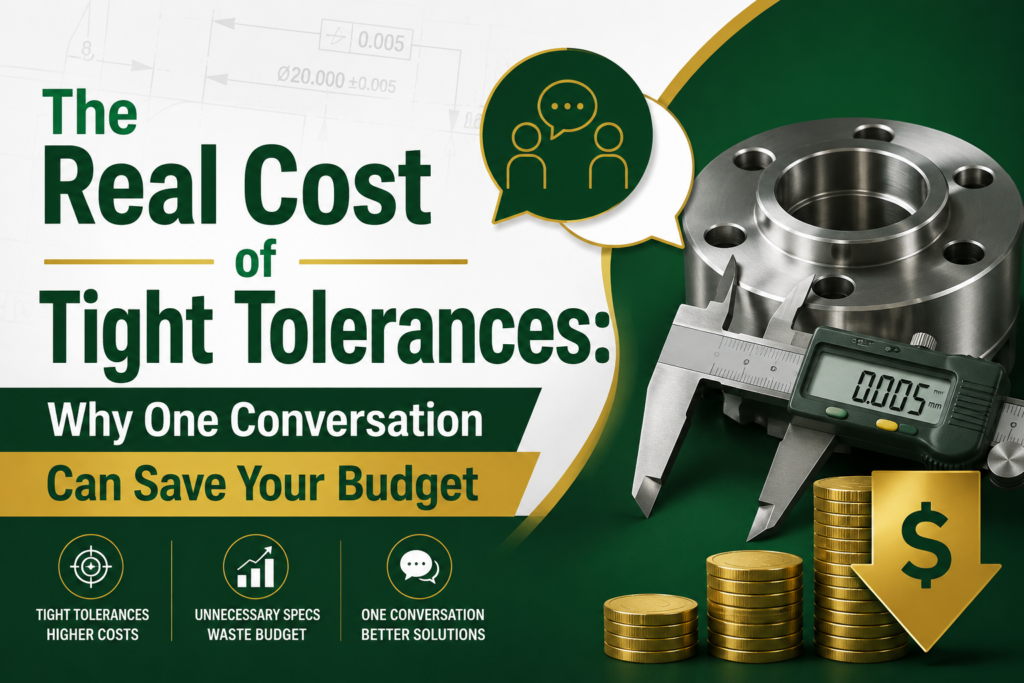
The Real Cost of Tight Tolerances: Why One Conversation Can Save Your Budget
On a print, a tolerance is just two numbers after a decimal point. On the shop floor, it can be the difference between a part that comes off a Swiss lathe in a single pass and a part that needs multiple setups, special tooling, secondary operations, and 100% inspection. In our experience quoting thousands of precision parts, the biggest driver of “sticker shock” usually isn’t material or volume — it’s a tolerance callout that quietly changes the entire manufacturing process.
Same Part, Two Very Different Price Tags
Consider a simple stainless steel shaft. Hold the overall dimensions to a standard ±0.005”, and it’s a straightforward job: one Swiss turning operation, standard tooling, in-process gauging, predictable cycle time. Now take that same shaft and tighten a single critical diameter to ±0.0002” — roughly the width of a soap bubble’s wall — and everything changes.
That tighter tolerance can mean slower feed rates to control tool deflection and thermal growth, a secondary grinding operation because turning alone can’t hold it reliably, temperature-controlled inspection instead of a quick caliper check, and CMM or air-gauge verification on every part instead of a sample plan. Scrap risk goes up, cycle time goes up, and the part may move across two or three processes instead of one. The geometry hasn’t changed — the price and lead time have, dramatically.
Where the Assumption Gap Happens
Tolerances often get carried forward from a legacy print, copied from a similar part, or added “just to be safe” without a clear picture of what achieving them actually costs. In other cases, a tight tolerance is genuinely required — for fit, function, or interchangeability with a mating component — and that’s essential information for us to have before we ever touch a piece of material.
The trouble is, a print alone doesn’t tell us which is which. A ±0.0002” callout looks the same on paper whether it’s load-bearing critical or a holdover from a decade-old revision. That gap between what’s specified and what’s actually needed is where budgets and schedules quietly get lost.
Why a Conversation Beats a Blind Quote
This is where a short conversation, ideally with the design engineer directly, pays for itself many times over. We’re not asking engineers to compromise performance — we’re asking which dimensions are truly functionally critical, which surfaces mate with other parts, and where there’s room to work with a more standard tolerance without affecting form, fit, or function.
The earlier this conversation happens, the more options are on the table. Raised before a print is finalized, it can lead to a design that’s easier and less expensive to manufacture from day one. Raised during quoting, it still gives everyone a chance to confirm intent before committing to tooling, fixturing, and a process plan built around a tolerance the part may not have actually needed.
Everybody Wins
When these conversations happen, the outcomes tend to look the same: a part that’s cheaper to produce, a shorter lead time, fewer engineering changes down the road, and a stronger working relationship between engineering, procurement, and the shop floor. Nobody is asked to lower their standards — the goal is simply making sure every tight tolerance on a print is there because the part needs it, not because no one asked.
At Fairchild Precision Parts, we treat that question as part of the job. Our team reviews new prints with an eye toward manufacturability, and when we see a tolerance that looks like it may be driving cost without adding value, we’ll raise it before we quote — not after the part is already in process. It’s a small conversation that consistently saves our customers real time and real money.
Let’s Talk Before You Finalize the Print
If you’re designing a new part or revisiting an existing one, loop us in early. A quick design-for-manufacturability discussion with our team can clarify which tolerances matter most and where there’s flexibility — often before a single line of the print is locked in.
Ready to see how this works on your next part? Request a quote or reach out to our engineering team to start the conversation.