
If you’re a machinist, a setup technician, or an operator standing at a Swiss lathe or a mill right now, you’ve probably heard the phrase “skilled labor shortage” so many times it’s turned into background noise. But the numbers behind that phrase are worth a second look, because they say something specific about where you sit in this industry right now — and it’s a stronger position than most people realize.
As of early 2026, U.S. manufacturers were reporting well over 400,000 open positions, and workforce researchers at Deloitte and The Manufacturing Institute have projected the sector could be short more than two million workers by the early 2030s if current trends hold. That’s not a story about a general shortage of people willing to work in a factory. General assembly roles are filling without much trouble. The gap is concentrated almost entirely in roles that require real judgment — machinists, CNC programmers, setup technicians, quality inspectors, maintenance techs — and wages in those roles have been climbing well above the broader manufacturing average. That wage growth is the labor market’s way of admitting these skills can’t simply be advertised into existence.
What’s Actually Retiring
The more useful way to understand this shortage isn’t as a headcount problem. It’s a knowledge-transfer problem. A large share of the most experienced machinists working today learned the trade in the 1980s and ’90s, and a significant portion of the current manufacturing workforce is approaching retirement age. When an operator who has run the same Swiss lathe for twenty-five years retires, a shop doesn’t just lose a set of hands. It loses the setup tweaks, the material quirks, the troubleshooting instincts that were never written into a work instruction because nobody ever had to write them down.
That’s the part of the shortage a stack of job applications can’t fix. You can hire someone new relatively quickly. Rebuilding twenty years of tribal knowledge inside their head takes considerably longer — unless a shop has already built a structure for passing that knowledge on before the people who hold it walk out the door.
Closing the Gap Takes Structure, Not Just Effort
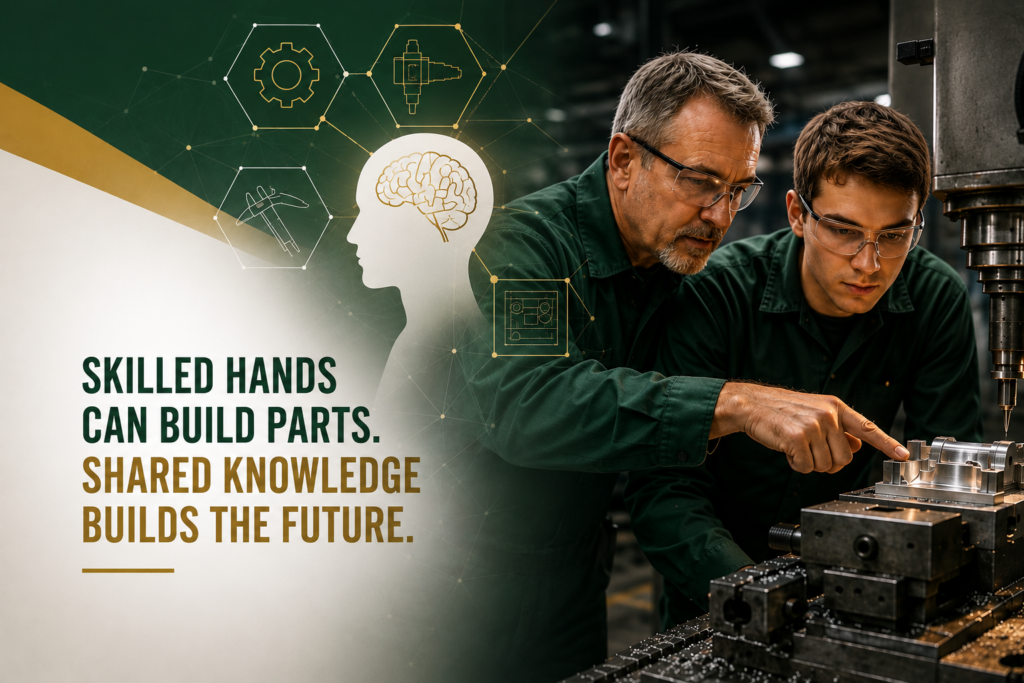
At Fairchild, we’ve approached this the same way we approach holding a ±0.0002″ tolerance: you don’t wing it and hope it comes out right, you build a repeatable process around it. Our apprenticeship approach deliberately pairs newer machinists and setup technicians with senior operators on the floor, rather than leaving new hires to absorb Swiss CNC or multi-axis milling knowledge by osmosis. The goal is to make the transfer of judgment — not just steps — an explicit part of someone’s first months on the job, instead of something that happens by accident if a mentor happens to have the patience and the time.
We’ve also started using tools that most shops wouldn’t immediately associate with training. Our in-house Bambu Lab P2S 3D printer, which we originally brought on for tooling and production-floor fixtures, has turned out to be just as useful for building training aids: printed mock-ups of part geometry and fixturing setups that let a new team member work through holding strategy, orientation, and setup logic before a single piece of stock is loaded into a machine. It’s a small thing, but it means the learning curve gets absorbed in plastic and a few hours, not in scrapped material and machine time.
What This Means If You’re Building a Career in This Trade
If you’re early in this trade, or thinking about entering it, the shortage cuts in your favor more than the headlines usually let on. Shops that are serious about staying competitive over the next decade aren’t looking for someone to stand at one station running the same part for years. They need people who can move across multiple machines, materials, and job types — and who can eventually become the person whose judgment other people are trained on. That range is exactly what tends to get rewarded, in both pay and responsibility, as the more experienced generation moves toward retirement.
It’s also worth being honest about what won’t fix this problem quickly. Automation and better software are part of the near-term answer for shops trying to protect throughput, but they don’t replace the judgment that comes from years of hands-on experience — they extend the reach of the people who already have it. The long-term fix is still apprenticeship, mentorship, and shops that treat training as infrastructure rather than an afterthought.
Where This Leaves the Industry in 2026
The skilled labor shortage in precision machining isn’t going away in the next year or two, and the shops that come out ahead of it won’t be the ones that simply posted more job ads. They’ll be the ones that built a real structure for moving knowledge from one generation of machinists to the next — apprenticeship pairing, documented setup logic, and yes, even a 3D printer pressed into service as a training tool. That’s the approach we’ve taken at Fairchild, and it’s the conversation we think the rest of the industry needs to be having, too.