
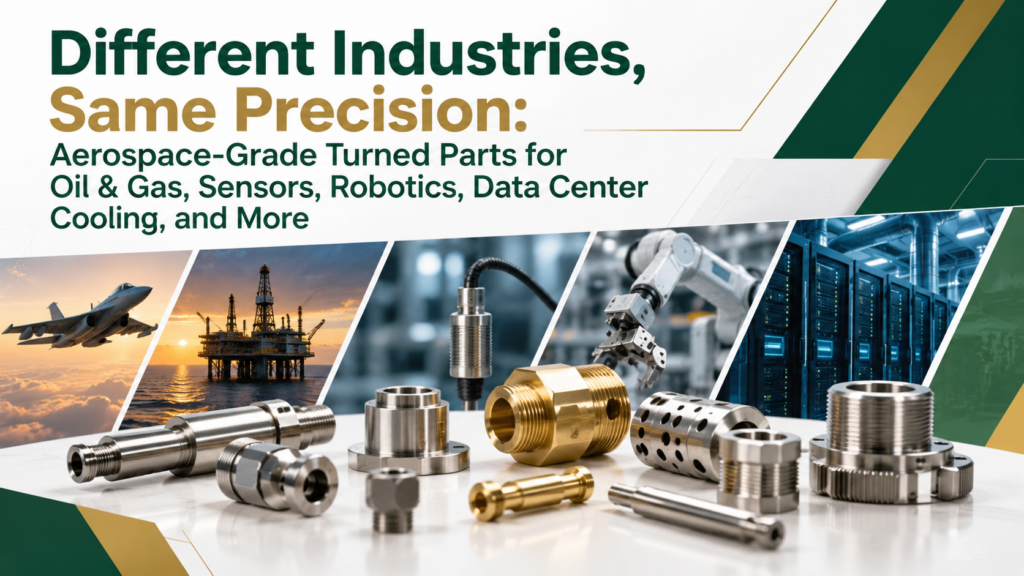
Put a print for a hydraulic fitting next to a print for a sensor housing used in a data center cooling loop. Strip off the title block, and a sourcing manager would have a hard time telling which one came from a defense program and which one came from a commercial OEM. Both are small, cylindrical, tight-tolerance turned parts. Both call for certified material, clean threads, controlled surface finishes, and documentation that holds up to an audit. And both need to arrive on the dock on the date promised, every release, for years.
That overlap is the reason this article exists. Fairchild Precision Parts has spent more than 80 years in Winsted, Connecticut making precision Swiss CNC turned parts for aerospace, defense, fluid control, and instrumentation supply chains. The same machines, people, and quality system that produce flight-critical components are a strong fit for any industry that buys small, demanding, high-volume turned parts. If you source components for oil and gas equipment, measurement devices, sensors, optics, electronics, liquid cooling systems, robotics, or commercial drones, the parts you buy probably look a lot like the parts we already make every day.
Below, we break down where the similarities are, what aerospace-level process discipline means for a non-aerospace buyer, and how to tell quickly whether your part is a good fit for a precision turned parts manufacturer like Fairchild.
Your Part Doesn’t Know What Industry It’s In
A CNC Swiss lathe doesn’t change its behavior based on the end market. What drives cost, quality, and lead time is the geometry on the print, the material, the tolerance stack, the quantity, and the documentation required to ship. On those terms, many industries ask for almost exactly the same thing.
Across the programs we quote, the common profile looks like this:
- Shape: round, cylindrical, or mostly-turned parts such as shafts, pins, fittings, bushings, sleeves, nozzles, housings, standoffs, contacts, and threaded bodies, often with cross-holes, flats, slots, or milled features.
- Size: small diameters, with Swiss-type work up to 1.25″ (32mm) bar stock and larger turned parts handled on CNC turning centers.
- Tolerances: tight diameters and true positions, with critical features held to ±0.0002″ where the design calls for it.
- Quantities: repeat production, from thousands of pieces on CNC turning to tens of thousands on Swiss, typically on scheduled releases.
- Requirements: material certifications, first article inspection, lot traceability, consistent finish and burr control, and reliable on-time delivery.
An aerospace valve spool and a fluid control valve stem for an industrial pump share far more than they differ. So do a defense connector pin and a contact for a commercial electronics assembly. Once you see your part through that lens, the question stops being “Does this shop serve my industry?” and becomes “Can this shop make my part well, repeatedly, and on time?”
What Aerospace-Level Discipline Means for Non-Aerospace Buyers
Fairchild is certified to AS9100D and ISO 9001:2015. If you don’t buy for aerospace, it’s fair to ask why that matters to you. The answer is practical: AS9100D builds additional controls on top of ISO 9001 around risk, traceability, configuration control, and product verification. Those controls don’t switch off when a commercial order comes through the door. Every customer gets the same system.
For a procurement or sourcing team, that shows up as fewer surprises:
- Traceability you can audit. Material certifications and lot records tie each shipment back to its raw material and production run, which matters when you’re answering to your own customer or investigating a field issue.
- Controlled first articles. New parts and revision changes are verified before production ramps, which reduces the risk of a bad lot reaching your assembly line.
- Documented processes. Setups, inspection plans, and work instructions are written down and repeatable, so the part you approve is the part you keep receiving.
- A culture of on-time delivery. Aerospace and defense supply chains are unforgiving about late parts. That expectation shapes how we plan capacity and releases for every customer, and we average roughly 95% on-time delivery.
In short, you get aerospace-grade process control without needing an aerospace part number.
Industry by Industry: Familiar Parts, Different Applications
Here is how the same turning capability maps to the markets where buyers are increasingly looking for a dependable domestic source.
Oil & Gas and Energy
Downhole tools, wellhead instrumentation, pressure regulators, and flow control equipment rely on precision fittings, valve stems, seats, nozzles, and threaded connectors. These parts often run in stainless steel, Inconel, and other corrosion-resistant alloys, and they see high pressure and harsh media. That calls for tight thread control, sealing surfaces with a consistent finish, and full material traceability. These are the same requirements we manage every day on high-temperature aerospace alloys.
Fluid Control, Valves, and Pneumatics
Fluid control has been part of Fairchild’s customer base for decades. Valve stems, poppets, spools, orifices, seats, and manifold fittings demand concentricity, roundness, and surface finishes that seal reliably over thousands of cycles. Brass, stainless steel, and engineered plastics like PEEK and Delrin are common choices. Swiss turning lets us finish many of these parts complete in one cycle, which improves consistency and keeps cost per part under control at volume.
Specialized Instrumentation and Measurement Devices
Analytical instruments, metrology equipment, flow meters, and test and measurement systems depend on small parts that have to be dimensionally stable and repeatable. Precision shafts, pivot pins, adjustment screws, probe bodies, and fittings are typical. In these products, a few ten-thousandths of an inch can affect calibration and accuracy, so tight tolerances and consistent lot-to-lot quality aren’t optional.
Sensors and Sensor Housings
Pressure, temperature, position, and proximity sensors are everywhere: in industrial automation, HVAC systems, vehicles, energy infrastructure, and data centers. Many of them are packaged in precision machined sensor housings, threaded bodies, probe tips, and protective sleeves. These parts usually combine an OD thread, a sealing face, internal bores for the sensing element, and cross-holes or flats, all of which a Swiss lathe with live tooling can produce in a single setup. Stainless steel and brass are common, with titanium or nickel alloys for harsher environments.
Optics and Photonics
Lens barrels, retaining rings, spacers, adjuster screws, and small mounts hold optical elements in exact alignment. These parts are often thin-walled and sensitive to distortion, and they may need fine threads and clean, burr-free edges. Aluminum, brass, and stainless steel are typical. The concentricity and finish control that Swiss turning delivers is well suited to optical assemblies, where small errors in alignment show up as measurable performance loss.
Electronics and Connectors
Connector pins, sockets, contacts, RF connector bodies, terminals, and standoffs are classic Swiss-turned parts: small diameter, high volume, and dimensionally critical. Brass and copper are common for conductivity, and plating requirements are often specified downstream. Because many of these parts are already produced for defense electronics, commercial electronics buyers benefit from a process that is proven at tight tolerances and high quantities.
Data Center Liquid Cooling
As AI and high-performance computing push rack power densities higher, more data centers are adopting direct-to-chip and other liquid cooling systems. That shift has created strong demand for leak-tight, small-diameter components such as quick-disconnect coupling bodies, manifold fittings, valve stems, sensor ports, and threaded adapters. The parts look a lot like fluid control and aerospace hydraulic components: stainless steel or brass, precision sealing surfaces, clean internal passages, and zero tolerance for leaks. For thermal management OEMs and their suppliers, a turned parts partner with fluid control experience and an established domestic supply base can shorten qualification and support fast scale-up.
Robotics and Industrial Automation
Robotic arms, end effectors, linear actuators, and automated assembly equipment use precision shafts, pins, bushings, spacers, encoder hubs, and actuator components. These parts need tight diameters for bearing and press fits, straightness on long slender features, and repeatable quality across production runs. Swiss turning is especially strong on long, small-diameter parts, because the guide bushing supports the material right at the cutting tool.
Drones and Unmanned Systems
Commercial drones and unmanned systems used in agriculture, inspection, mapping, and logistics need lightweight, precise components: motor shafts, gimbal pins, standoffs, threaded inserts, and small housings, often in aluminum or titanium. Weight, balance, and fit all affect flight performance and reliability. These are exactly the kinds of parts and materials that aerospace experience prepares a shop to handle.
Industrial Equipment and OEM Machinery
Pumps, compressors, HVAC systems, packaging machinery, and general industrial equipment all depend on turned components that need to fit and perform the same way in every unit built. For industrial OEMs, the priorities are usually predictable cost, consistent quality, and dependable delivery, which is where long-term blanket order programs work well.
Example scenario: A sensor OEM sources a 316 stainless steel threaded housing with a sealing face, an internal bore, and a cross-drilled port, at about 20,000 pieces a year. On a Swiss lathe with live tooling, the part can be completed in one setup instead of three operations, lowering handling, improving concentricity between features, and supporting scheduled monthly releases under a blanket order.
Side-by-Side: How the Requirements Compare
The table below shows how closely part profiles line up across industries. The end use changes, but the requirements on the print stay very similar.
| Industry | Typical turned parts | Common materials | Typical requirements |
| Aerospace & defense | Hydraulic fittings, valve spools, pins, connector contacts | Stainless, titanium, Inconel, aluminum | Tight tolerances, full traceability, first article |
| Oil & gas | Valve stems, seats, nozzles, threaded connectors | Stainless, Inconel, alloy steel | Pressure-rated threads, sealing finishes, material certs |
| Fluid control | Poppets, spools, orifices, manifold fittings | Brass, stainless, PEEK, Delrin | Concentricity, roundness, leak-free sealing |
| Instrumentation & measurement | Precision shafts, pivot pins, probe bodies | Stainless, brass, tool steel | Dimensional stability, lot-to-lot repeatability |
| Sensors | Housings, threaded bodies, probe tips | Stainless, brass, titanium | Multi-feature parts, sealing faces, tight bores |
| Optics | Lens barrels, retaining rings, adjuster screws | Aluminum, brass, stainless | Thin walls, fine threads, burr-free edges |
| Electronics | Pins, sockets, contacts, RF bodies | Brass, copper | High volume, small diameters, tight tolerances |
| Data center cooling | Coupling bodies, fittings, valve stems, adapters | Stainless, brass | Leak-tight sealing, clean passages, scale-up capacity |
| Robotics & drones | Shafts, bushings, standoffs, gimbal pins | Aluminum, titanium, steel | Press and bearing fits, straightness, light weight |
What Procurement and Sourcing Teams Gain
Engineering cares whether the part meets the print. Procurement also has to care about total cost, risk, and continuity of supply. That’s where a long-term turned parts partner earns its place on your approved vendor list.
Lower Total Cost, Not Just a Lower Piece Price
Swiss CNC turning often finishes parts complete in a single cycle, so secondary operations, handling, and scrap are reduced. When we review a print, we also look for tolerance or feature changes that could lower cost without affecting function, and we share them with your team before quoting. A small change to an over-specified tolerance can make a meaningful difference across a high-volume program.
Predictable Lead Times and Flexible Releases
New parts typically ship in 6 to 8 weeks, and repeat orders in 4 to 6 weeks. For ongoing programs, blanket order agreements with flexible release schedules let you lock in pricing and capacity while pulling parts as your production demands. That reduces your inventory carrying costs and the administrative work of placing a new PO for every lot.
Supplier Consolidation
Because we work across brass, copper, aluminum, steel, stainless steel, tool steel, titanium, Inconel, PEEK, Delrin, and specialty alloys, many buyers can move a family of turned parts to one qualified source. Fewer suppliers means fewer audits, fewer quality agreements, and a simpler supply chain to manage.
Domestic, Reliable Supply
Tariffs, freight volatility, and long overseas lead times have pushed many OEMs to reshore critical components. A domestic, certified Connecticut supplier gives you shorter transit times, easier communication across time zones you already work in, and the ability to visit the shop floor when it matters.
Is Your Part a Good Fit? A Quick Checklist
Before sending an RFQ, you can check whether your part matches our strengths. If most of these apply, we should talk:
- The part is mostly round or cylindrical, with turned features plus possible cross-holes, flats, slots, or threads.
- The diameter fits on Swiss-type bar stock up to 1.25″ (32mm), or the part is suited to CNC turning for larger sizes.
- Critical features call for tight tolerances, down to ±0.0002″.
- Annual demand is in the thousands to tens of thousands of pieces, ideally on recurring releases.
- The material is a metal or engineered plastic such as stainless steel, brass, aluminum, titanium, Inconel, PEEK, or Delrin.
- You need material certifications, first article inspection, and traceable lots.
If your part falls outside this profile, ask anyway. Our team will tell you plainly whether it’s a fit, and if it isn’t, we’ll say so rather than quote something we can’t make well.
A Precision Machining Partner for Connecticut, New England, and Beyond
Fairchild has been machining parts in Winsted, Connecticut since 1944. Our location in Litchfield County puts us within easy reach of manufacturers across the Hartford, Waterbury, Torrington, New Haven, and Fairfield County areas, along with the broader New England manufacturing corridor in Massachusetts and Rhode Island and the Northeast markets of New York, New Jersey, and Pennsylvania. We also ship turned parts to OEMs and Tier 2 suppliers across the United States.
For buyers searching for Swiss CNC machining in Connecticut or a New England precision machining partner, that combination of regional proximity, national reach, and aerospace-level certification is hard to find in one supplier.
Frequently Asked Questions
Does Fairchild Precision Parts work with industries outside aerospace and defense?
Yes. In addition to aerospace and defense, Fairchild produces precision turned parts for fluid control, instrumentation, oil and gas, sensors, electronics, industrial equipment, and other commercial markets. The same Swiss CNC and CNC turning capabilities apply to any industry that needs small, tight-tolerance, high-volume parts.
Why does AS9100D certification matter if my parts aren’t for aerospace?
AS9100D adds controls for risk, traceability, configuration management, and product verification on top of ISO 9001. Fairchild applies that same quality system to every order, so commercial customers benefit from aerospace-level process control and documentation.
What size parts can Fairchild make on its Swiss CNC lathes?
Fairchild’s Swiss-type lathes run bar stock up to 1.25″ (32mm) in diameter. Larger turned parts are produced on CNC turning centers.
What tolerances can Fairchild hold on turned parts?
Fairchild holds tolerances down to ±0.0002″ on critical features, depending on part geometry and material.
What order quantities does Fairchild handle?
Swiss CNC production commonly runs in the tens of thousands of pieces, and CNC turning in the thousands. Blanket orders with flexible release schedules are available for recurring programs.
What are Fairchild’s typical lead times?
New parts typically ship in 6 to 8 weeks, and repeat orders in 4 to 6 weeks, with on-time delivery averaging around 95%.
Can Fairchild make components for data center liquid cooling systems?
Yes. Liquid cooling components such as coupling bodies, fittings, valve stems, and threaded adapters are closely related to the fluid control parts Fairchild already produces in stainless steel and brass, with the same focus on sealing surfaces and leak-tight performance.
Where is Fairchild Precision Parts located?
Fairchild Precision Parts is located in Winsted, Connecticut, and serves manufacturers across Connecticut, New England, the Northeast, and the rest of the United States.
Let’s Talk About Your Next Turned Part
Whatever industry your parts serve, the questions that matter are the same: Can the supplier hold the print? Can they do it at volume? Will the parts arrive on time, every time? Since 1944, Fairchild has answered those questions for manufacturers who can’t afford to get them wrong, backed today by AS9100D and ISO 9001:2015 certification.
If you’re sourcing precision turned parts for oil and gas, instrumentation, sensors, optics, electronics, data center cooling, robotics, drones, or industrial equipment, send us your print. Our team will review it, share any ideas to improve manufacturability or cost, and give you a clear, competitive quote.
Request a quote today or contact our team to discuss how Fairchild can become your long-term precision machining partner.