
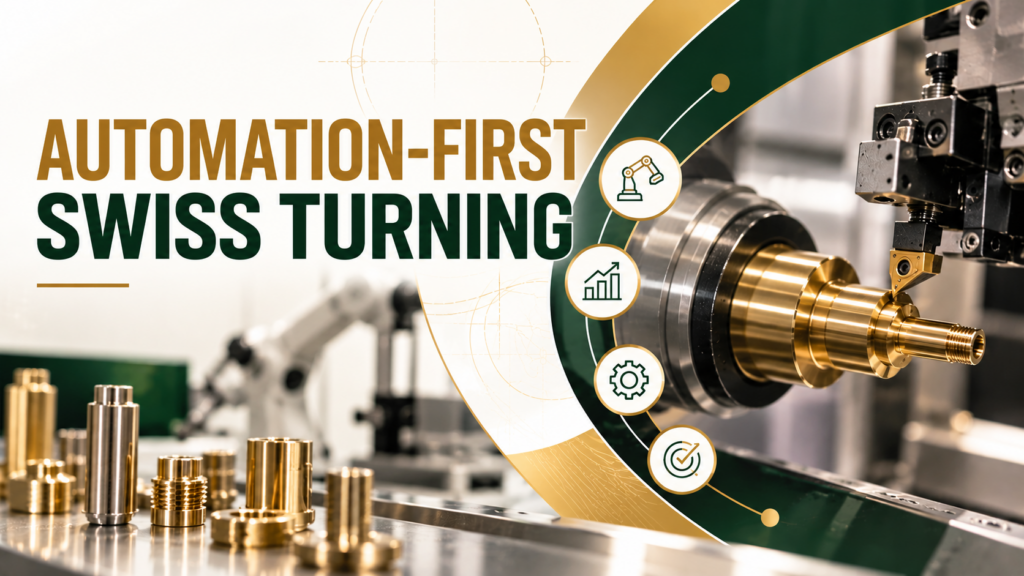
Look at the machine shops earning recognition in 2026 and a pattern shows up quickly. Before they buy a new machine, they ask one question first: how will we automate it? Modern Machine Shop’s 2026 Top Shops coverage highlighted exactly that mindset this fall, and machine builders are moving the same way. Haas, for example, just introduced compact dual-spindle turning machines built to finish more of the part in a single cycle.
For Tier 2 aerospace and defense suppliers, this isn’t really an equipment story. It’s a supply story. When OEM build rates climb and your own backlog stretches, the shops you depend on for precision turned components either have capacity that scales, or they become the bottleneck in your schedule.
At Fairchild Precision Parts in Winsted, Connecticut, we’ve been producing precision turned parts since 1944. Here’s what automated Swiss CNC turning actually delivers to suppliers across the Northeast aerospace and defense corridor, and what to ask before you trust a machining partner with your next program.
Why Automation Became the First Question in CNC Machining
Three pressures have converged on precision machining. Skilled machinists are harder to hire and harder to replace. Aerospace and defense demand keeps backlogs long across the supply chain. And customers expect tighter tolerances, full traceability, and stable pricing all at once.
Automation answers all three. It lets an experienced machinist oversee more spindles, keeps machines cutting through breaks and shift changes, and removes manual part handling, which is one of the most common sources of dimensional variation. The broader market reflects the shift: an industry forecast released this month projects the global machine tool market to grow at roughly 6.5% a year through 2034, driven largely by CNC automation and smart-factory investment.
Swiss Turning Was Built for Automation
Of all CNC processes, Swiss-type turning may be the most naturally suited to automation. Bar stock feeds continuously through a guide bushing. The main spindle and sub-spindle machine both ends of the part, while live tooling handles cross-holes, flats, slots, and milled features. The part comes off the machine finished, with no re-chucking, no second-operation fixtures, and no operator handling between steps.
That’s why Swiss CNC machining dominates high-volume production of small, tight-tolerance cylindrical parts such as:
- Hydraulic and pneumatic fittings, valve stems, and fluid control components
- Pins, shafts, spacers, and bushings for actuation and flight control systems
- Connector bodies, contacts, and sensor housings for defense electronics
- Precision components for instrumentation and test equipment
At Fairchild, our Citizen Swiss-type lathes run bar stock up to 32 mm (1.25″) in diameter and routinely support production runs in the tens of thousands, complemented by Doosan CNC turning centers for larger turned parts and lower-volume work.
What Automated Swiss CNC Turning Delivers to Tier 2 Suppliers
Part-to-Part Consistency You Can Build Around
Every time a person loads, unloads, or re-fixtures a part, variation has a chance to enter. Complete-in-one-setup machining removes most of those touch points, so part 10,000 matches part 10. For a Tier 2 supplier feeding an assembly line or an OEM’s receiving inspection, that consistency means fewer rejects, fewer nonconformance reports, and fewer surprises during customer audits.
Consider a common scenario: a stainless steel hydraulic fitting that once required a lathe operation plus a separate milling setup for its cross-holes. Moving it to a single Swiss cycle with live tooling eliminates a fixture, a handling step, and a second inspection point, cutting both lead time and the opportunity for error.
Capacity That Holds When Demand Spikes
Automated, bar-fed equipment keeps running between shifts and through breaks, which lets a shop absorb larger release quantities without immediately adding headcount. When an aerospace or defense program ramps, that headroom is the difference between a supplier who keeps pace and one who asks you to push out dates.
Predictable Lead Times and Delivery
Fairchild’s new-part lead times typically run 6–8 weeks, with repeat orders at 4–6 weeks, and our on-time delivery averages approximately 95%. Blanket order programs with flexible release schedules let you secure pricing and capacity up front, then pull parts as your own build schedule requires.
Lower Total Cost, Not Just Lower Piece Price
Automation reduces labor content per part, but the larger savings often sit elsewhere: less scrap, fewer secondary operations, fewer expedite fees, and smaller safety stock because you can trust the delivery date. For procurement teams, total cost of ownership is the number worth measuring.
Automation Doesn’t Replace Expertise. It Multiplies It.
A bar feeder doesn’t know when a tool is beginning to wear, when Inconel needs a different feed strategy, or when a print callout will cause trouble in production. People do. The real value of automation is that it extends the judgment of experienced machinists, programmers, and quality professionals across many more spindle hours.
That expertise matters most on demanding aerospace and defense materials. Fairchild machines titanium, Inconel, stainless and tool steels, aluminum, brass, copper, PEEK, Delrin, and specialty aerospace alloys. Every job runs under our AS9100D and ISO 9001:2015 certified quality management system, with production and inspection records managed digitally through our ProShop ERP for clear, lot-level traceability.
Why a Northeast Precision Machining Partner Strengthens Your Supply Chain
Winsted sits in northwest Connecticut, in the middle of one of the densest aerospace and defense manufacturing regions in the country. Connecticut alone is home to major jet engine, helicopter, and submarine programs, and Tier 2 suppliers across Massachusetts, Rhode Island, New York, New Jersey, Pennsylvania, New Hampshire, Vermont, and Maine support the same primes.
Working with a Northeast-based Swiss turning supplier gives you practical advantages:
- Shorter transit: ground shipping measured in days, not weeks of ocean freight and port delays.
- Easier oversight: source inspections, first article reviews, and supplier audits within a few hours’ drive of most of the Northeast corridor.
- Aligned communication: same time zone, quick engineering conversations, and faster answers when a print changes.
- Domestic production: S.-made parts that simplify country-of-origin documentation and reduce exposure to tariff and trade disruptions.
Five Questions to Ask a Swiss Turning Supplier About Automation
Before you award your next turned-parts program, ask these questions. The answers reveal more than a quote ever will.
- Which operations are completed in one setup, and which still require secondary operations?
- How do you monitor tool wear and dimensional drift during long production runs?
- How are in-process and final inspections documented, and how is traceability maintained by lot?
- What capacity can you commit if our release quantities increase 25% or more?
- Is your quality system certified to AS9100, and can we schedule an audit?
Frequently Asked Questions
What is automated Swiss CNC turning?
Automated Swiss CNC turning is a machining process in which bar stock is fed continuously into a Swiss-type lathe, which uses a guide bushing, main and sub-spindles, and live tooling to machine small, precise parts complete in a single cycle with minimal manual handling.
What types of parts are best suited to Swiss turning?
Swiss turning is ideal for small, cylindrical, tight-tolerance parts produced in moderate to high volumes, such as fittings, pins, shafts, valve components, and connector bodies. Fairchild’s Swiss lathes handle bar stock up to 32 mm (1.25″) in diameter.
Does automation lower the cost of precision turned parts?
Yes. Automation reduces labor per part, but the larger savings usually come from lower scrap, fewer secondary operations, more reliable delivery, and less safety stock, which together reduce total cost of ownership.
Is automated machining reliable enough for aerospace and defense parts?
Yes, when it operates within a certified quality system. Automation reduces handling-related variation, and an AS9100-certified supplier adds documented inspection, process control, and traceability on top of it.
Where is Fairchild Precision Parts located, and which regions do you serve?
Fairchild Precision Parts is located in Winsted, Connecticut. We serve aerospace, defense, fluid control, and instrumentation manufacturers throughout the Northeast, including Connecticut, Massachusetts, Rhode Island, New York, New Jersey, and Pennsylvania, as well as customers nationwide.
What lead times should I expect for Swiss turned parts?
At Fairchild, new parts typically ship in 6–8 weeks and repeat orders in 4–6 weeks. Blanket order programs with scheduled releases can shorten effective lead times further.
Build Your Next Program on Capacity You Can Count On
Automation is reshaping precision machining, but what matters to your program is the result: consistent parts, scalable capacity, and delivery dates you can plan around. Since 1944, Fairchild Precision Parts has helped aerospace, defense, and industrial manufacturers turn tight-tolerance designs into reliable production, backed by AS9100D and ISO 9001:2015 certification.
If you’re planning a new program, consolidating suppliers, or need more dependable capacity for an existing part, send us your print. Request a quote or talk with our team about a blanket order program built around your build schedule.