
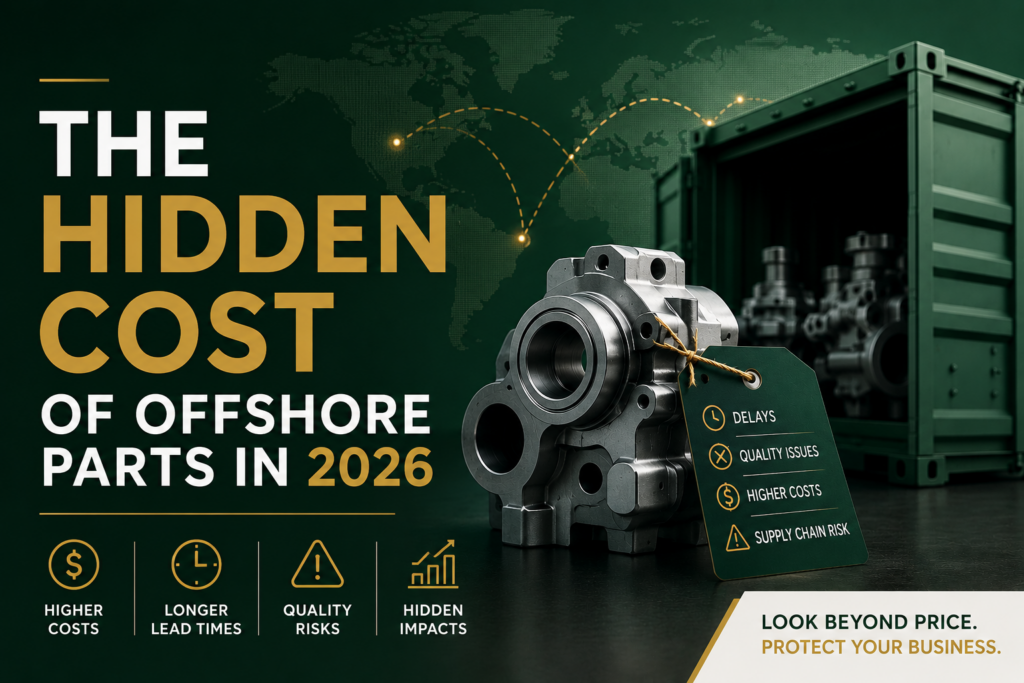
The Hidden Cost of Offshore Parts in 2026
A Buyer’s Guide to Tariffs and the True Cost of Precision-Machined Components
If you’re sourcing precision-machined components in 2026, tariffs are no longer a background variable in your cost model — they’re a front-line budget problem. Landed cost on offshore turned parts has climbed significantly, lead times from overseas suppliers remain unpredictable, and engineering teams are spending more time managing exceptions than qualifying new parts.
This guide breaks down where tariff costs are actually hitting buyers of precision CNC-machined components, what’s often left out of the offshore cost comparison, and what a strong domestic sourcing relationship can do about it.
Where Tariffs Are Actually Hitting Your Budget
The 2025 tariff landscape — and its continuation into 2026 — has created a multi-layer cost problem for procurement teams sourcing turned parts from overseas. The raw material surcharge is the visible part. But buyers consistently underestimate where the real erosion happens:
- Raw material surcharges passed through by overseas suppliers. Steel, stainless, brass, and aluminum tariffs have been passed downstream. Raw material prices rose an average of 5.4% in 2025 and are projected to rise another 4.4% in 2026.
- HS code reclassification risk. Precision components — connectors, fittings, valve bodies, shafts — are frequently reclassified under tariff schedules in ways that can push effective duty rates from the low single digits to 25% or higher. If your supplier is handling classification and you’re not auditing it, you may not know until the bill arrives.
- Inventory buffering costs. Extended offshore lead times force buyers to carry 60–120+ days of safety stock, tying up capital and warehouse space that would otherwise be deployed elsewhere.
- Expedite and airfreight premiums. When an offshore supplier misses a delivery window — increasingly common given container shipping volatility — the cost to recover via air freight can dwarf the per-part savings that justified the offshore source in the first place.
- Engineering and re-qualification time. Supplier qualification is not free. When offshore quality or delivery performance degrades, the hidden cost of re-qualifying a new source — print reviews, FAIs, PPAP-equivalent documentation, inspection time — can run into the thousands of dollars per part number.
The Offshore Cost Comparison: What’s Usually Missing
Most offshore cost comparisons are built on a simple unit price delta. That analysis made sense in a low-tariff, stable-logistics environment. In 2026, it routinely leaves out:
- Total landed cost (unit price + freight + duties + insurance + carrying cost of extended lead-time inventory)
- Tariff exposure on raw material content — particularly relevant for brass, stainless steel, and titanium components where material is a significant share of part cost
- Supplier quality risk premium — rework, scrap, and sorting costs when offshore first-article failure rates are higher
- Program management overhead — the time your team spends chasing status, resolving customs issues, and managing exception reports
- Schedule risk multiplier — on-time delivery performance for offshore precision machined parts has declined meaningfully since 2023; every late shipment has downstream program consequences
A more complete model looks like this:
Offshore vs. Domestic
Unite Price: Offshore often lower — but narrowing as labor and tariff costs rise
Duties & Tariffs: Offshore: 3–50%+ depending on HS code. Domestic: none
Lead time / safety stock cost: Offshore: 60–120+ day buffer required. Domestic: 2–6 weeks typical
Freight & logistics risk: Offshore: high volatility, rising costs. Domestic: predictable
Quality risk / rework: Offshore: variable. AS9100/ISO 9001 domestic: tightly controlled
Program Management overhead: Offshore: significant. Domestic partner: minimal
What Domestic Sourcing Actually Delivers
Moving production to a qualified domestic CNC machining partner isn’t just a tariff hedge. For buyers in aerospace, defense, fluid control, and instrumentation, it changes the risk profile of the supply chain in several measurable ways:
No tariff exposure on finished parts.
Parts machined domestically from domestic-source or tariff-exempt raw material carry no import duty. For high-volume Swiss-turned components — fittings, shafts, valve bodies, connector housings — that’s a real, calculable line-item reduction in total landed cost.
Compressed lead times — and meaningful blanket order programs.
A domestic Swiss CNC shop running production volumes (tens of thousands of pieces per part number) can support lead times in the 2–4 week range for qualified parts on blanket orders, with scheduled releases against a firm annual volume. That’s not possible with an overseas supplier 8,000 miles away managing container logistics.
Tighter quality alignment — especially for AS9100 and ISO 9001 programs.
Aerospace and defense supply chains require documented quality management. AS9100 Rev D certification from a domestic manufacturer means your supplier is operating under a quality system directly auditable by your team — no time zone gaps, no translation layers, no third-party audit proxies.
Real-time communication when it matters.
When a material certification question comes up, when a drawing revision needs a fast turnaround response, or when a delivery window needs to shift — a domestic partner picks up the phone. Offshore escalation chains add days you usually don’t have.
Questions Buyers Should Be Asking Right Now
If you’re evaluating your precision parts supply chain mid-2026, these are the questions worth pressure-testing:
- What is my true landed cost per part, including duties, freight, and safety stock carrying cost?
- What is my offshore supplier’s on-time delivery rate over the past 12 months — and what did exceptions cost me?
- Do I have HS code classification documentation for each part number, and is it current?
- If my offshore supplier misses a shipment, what is my recovery plan — and what does it cost?
- Does my domestic backup source have the capacity and certification to absorb a transfer?
- Am I carrying the right inventory buffer, or am I carrying excess stock to compensate for supplier unpredictability?
How Fairchild Supports Domestic Precision Parts Sourcing
Fairchild Precision Parts has been producing tight-tolerance CNC-machined components from our Winsted, Connecticut facility since 1944. We hold AS9100 Rev D and ISO 9001:2015 certification, and our core capabilities — Swiss CNC turning for high-volume small-diameter parts and CNC turning/milling for larger, more complex geometries — are built around exactly the part profiles that buyers are looking to reshore.
- Swiss CNC turning up to 32mm (1.25″) diameter with tolerances held to ±0.0002″
- Production volumes in the tens of thousands of pieces per part number
- Materials include brass, copper, aluminum, 300 and 400 series stainless steel, titanium, Inconel, PEEK, Delrin, and more
- Blanket order programs with flexible release schedules to reduce your inventory burden
- Turnkey services — Fairchild manages secondary operations, plating, heat treatment, and assembly so you receive finished parts, not blanks
- Long-term production partnerships with Tier 2 aerospace, defense, fluid control, instrumentation, and industrial customers
We’re not a job shop chasing single-run quotes. We’re a production partner — and in a tariff environment where supply chain reliability and total landed cost matter more than they have in a generation, that distinction is worth a conversation.
Ready to Talk About Your Parts?
If you have high-volume precision-machined components currently sourced offshore — or if you’re building a contingency plan — we’d welcome the conversation. Request a quote, send us a print, or reach out to our team directly to discuss how Fairchild can support your supply chain.
→ Request a Quote: sales@fairchildparts.com
→ Call us: (860) 379-2725