
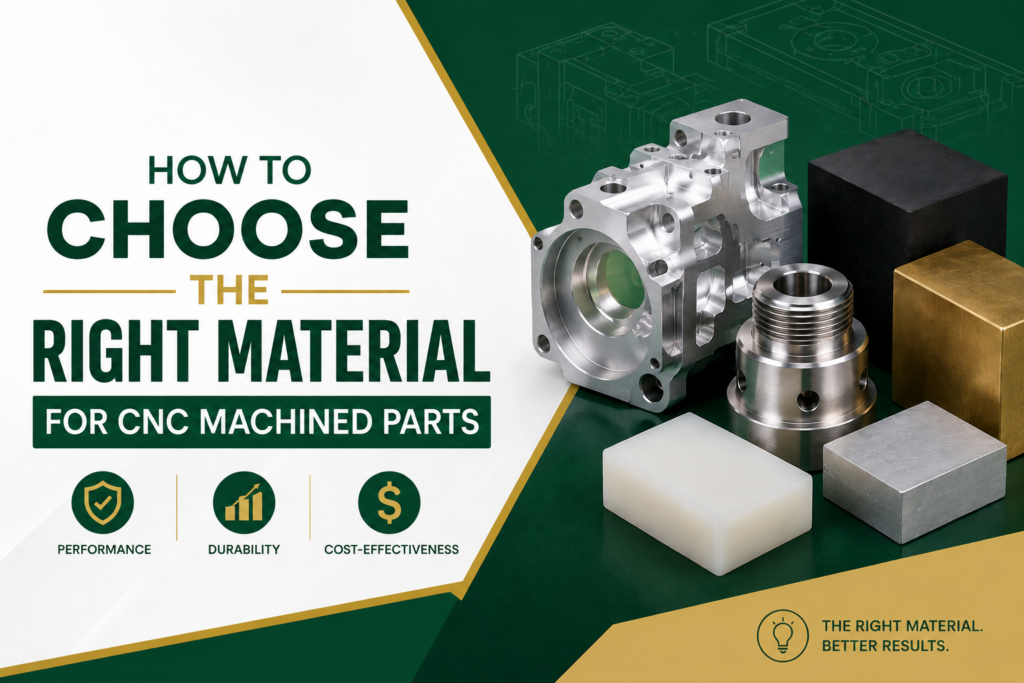
How to Choose the Right Material for CNC Machined Parts
Every precision machined part starts with a decision that shapes everything that follows: what material is it made from? Get that choice right, and you have a component that meets spec, machines efficiently, and holds up in service. Get it wrong, and you’re looking at scrapped parts, blown tolerances, or field failures that cost far more than the price of the original order.
At Fairchild Precision Parts, we work with engineers and procurement teams across aerospace, defense, fluid control, instrumentation, and industrial markets. Material selection questions come up in nearly every new program. The right answer is rarely obvious, and it almost never comes down to just one factor.
Here’s how we think about it — and what we look for when helping customers make that call.
Start With the Application, Not the Material
The most common mistake in material selection is working backwards from a preferred material rather than forward from the application’s actual demands. Before any material conversation, we want to understand the operating environment:
- What temperatures will the part see?
- Is it exposed to chemicals, moisture, or pressure?
- Does it carry a structural load, or is it primarily a functional form?
- What are the tolerance and surface finish requirements?
The answers narrow the field quickly. A fluid control fitting that lives in a corrosive hydraulic system has different priorities than an aerospace structural bracket or an instrumentation housing. Matching the material to the actual operating conditions — rather than defaulting to what was spec’d last time — is where good material decisions begin.
The Materials We Work With Most
Brass
- Brass remains one of the most machinable materials available, which is a significant advantage in high-volume Swiss turning. It holds tight tolerances well, produces excellent surface finishes, and offers natural corrosion resistance in many fluid environments.
- It’s a common choice for fluid control components, fittings, and instrumentation hardware where machinability and cost efficiency both matter.
Aluminum
- Aluminum’s strength-to-weight ratio makes it a staple of aerospace and defense programs. It machines cleanly, is available in a wide range of alloys, and responds well to secondary finishing processes like anodizing.
- For parts where weight is a design constraint, aluminum is frequently the first option evaluated. 6061 and 7075 are the alloys we see most often.
Stainless Steel
- When corrosion resistance and strength both matter, stainless steel is usually in the conversation. Grades like 303 and 316 are workhorses in fluid control and instrumentation applications. They’re harder on tooling than brass or aluminum, but their durability and compatibility with harsh environments often justify the tradeoff.
- For tight-tolerance turned parts in demanding service environments, stainless is a reliable choice.
Steel and Tool Steel
- Carbon and alloy steels are selected for applications that require high strength and wear resistance. Tool steels, while more demanding to machine, are used in parts that must withstand repeated mechanical stress or elevated hardness requirements.
- These materials are common in defense and industrial programs where structural performance is non-negotiable.
Titanium
- Titanium’s combination of high strength, low weight, and excellent corrosion resistance makes it highly attractive for aerospace and defense applications. It’s also notoriously difficult to machine: it generates heat, is prone to work hardening, and puts significant demands on tooling and process parameters. Getting titanium right requires experience and careful process control — cutting speeds, feed rates, and coolant strategy all matter.
Inconel and Nickel Alloys
- Inconel and similar nickel-based superalloys are specified for extreme-environment applications: high temperatures, oxidizing atmospheres, and aggressive corrosive conditions. They’re among the most challenging materials to machine — slow cutting speeds, high tooling wear rates, and work hardening are all in play.
- These are specialty materials that demand precision process engineering, not just programming capability.
PEEK and Engineered Plastics
- Polyether ether ketone (PEEK) and similar engineering-grade plastics are increasingly specified in applications where weight reduction, chemical resistance, or electrical insulation are priorities. PEEK has excellent mechanical properties and holds tolerances well, making it a viable alternative to metals in certain instrumentation and fluid system applications.
- Delrin (acetal) is another common choice where lower cost and good machinability are the primary drivers.
Machinability Is Part of the Cost Equation
Material cost per pound is only one number in the equation. Machinability — how a material behaves when being cut — directly affects cycle time, tooling consumption, scrap rates, and ultimately the per-part price. A harder material may require slower feeds and speeds, more frequent tool changes, and tighter in-process monitoring. Over a production run of tens of thousands of parts, those differences add up significantly.
When we review a new part for manufacturability, we factor in how the material will behave on our Swiss lathes and CNC turning centers, whether any secondary operations are needed, and what the realistic scrap exposure looks like. In some cases, a slightly more expensive material with better machinability produces a lower total part cost than a cheaper material that machines poorly.
Availability, Lead Time, and Supply Chain Stability
Even the right material is the wrong choice if it isn’t reliably available. Exotic alloys and specialty materials can carry long mill lead times, limited supplier options, and price volatility that complicates production planning. For high-volume production programs, material availability is a supply chain risk factor that deserves serious attention at the design stage.
Fairchild maintains close supplier relationships and works with customers on blanket order programs that help stabilize material supply and pricing over time. For programs where material lead time is a concern, we can work through sourcing strategy alongside the manufacturing review — before it becomes a schedule problem.
Certifications and Traceability Requirements
Aerospace and defense programs routinely require certified material with full traceability: mill certificates, heat/lot tracking, and documented chain of custody from raw stock to finished part. Fairchild’s AS9100 Rev D and ISO 9001:2015 certified quality system is built around exactly these requirements. We work with certified material suppliers and maintain the documentation our customers need to satisfy their own quality obligations.
If your program has specific material certification requirements — AMS specs, ASTM standards, or customer-specific source controls — bring those requirements in with your drawing package. We’ll confirm compatibility during the manufacturing review process before any material is ordered.
When to Have the Material Conversation Early
The best time to evaluate material alternatives is during the design phase, before drawings are released and production commitments are made. Design for manufacturability (DFM) reviews often surface material substitutions that reduce cost, improve machinability, or eliminate secondary operations — without compromising the part’s functional performance.
If you’re bringing a new part to production and have any flexibility on material, it’s worth a conversation. Our engineering team has decades of experience evaluating parts for manufacturability and cost reduction opportunities, and we’ll tell you directly if a material substitution is worth exploring.
Let’s Talk About Your Next Program
Whether you’re sourcing a proven production part or bringing something new to market, Fairchild Precision Parts has the material expertise, Swiss CNC capability, and certified quality system to deliver. We machine brass, copper, aluminum, steel, stainless steel, titanium, Inconel, PEEK, Delrin, and more — to tolerances as tight as ±0.0002”.
Contact us to request a quote or discuss your program. Our team is ready to help you get material selection right from the start.