
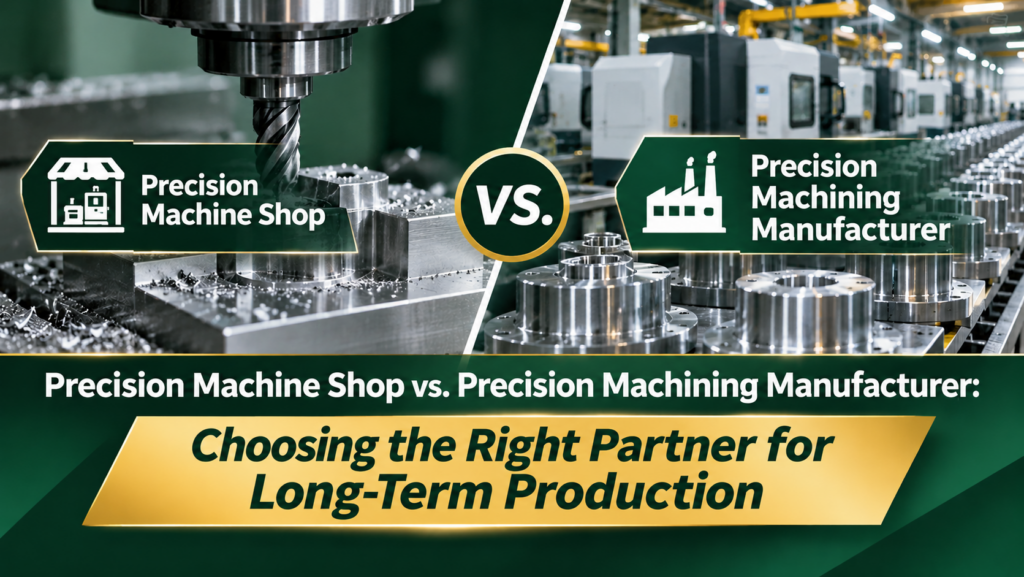
If you source tight-tolerance components for aerospace, defense, fluid control, or instrumentation programs, you have probably used the terms “precision machine shop” and “precision machining manufacturer” interchangeably. Most buyers do, and so do most search results. But behind those two labels are two very different business models, and the one you choose has a direct effect on your unit cost, your quality risk, and how much of your team’s time goes to managing suppliers instead of building product.
Both play an important role in the Northeast manufacturing base. A precision machine shop gives engineers flexibility and speed for prototypes and short runs. A precision machining manufacturer is built for something else: producing the same critical parts, to the same standard, month after month and year after year.
In this guide, we break down the real differences, explain how each model affects cost, quality, and supply continuity, and help you decide which type of partner fits your program. As a precision machining manufacturer in Winsted, Connecticut, since 1944, Fairchild Precision Parts works with OEMs and Tier 2 suppliers across New England who ask this question every time they evaluate a new source.
Why the Difference Matters More in Today’s Supply Chain
For years, many procurement teams treated machined parts as interchangeable. Send out the drawing, collect three quotes, award to the lowest number. That approach can work for a one-off bracket. It breaks down when the part is a valve stem in a flight-critical fluid control assembly, or a connector pin that ships by the tens of thousands every quarter.
Several pressures have changed the math for buyers across New England and the broader Northeast:
- Stretched capacity. Aerospace and defense backlogs are pushing supplier capacity to its limits, which makes a reliable capacity commitment worth more than a low quote.
- Domestic sourcing. Reshoring and tariff pressure are bringing more programs back to U.S. suppliers, and buyers need partners who can absorb that volume without slipping.
- Rising quality expectations. Traceability and documentation requirements keep tightening, especially in AS9100 supply chains.
- Leaner procurement teams. Every supplier that needs constant follow-up, expediting, or re-quoting is a hidden cost.
Under those conditions, the question is no longer just “who can make this part?” It is “who can make this part reliably, at volume, for the life of the program?” That is where the distinction between a precision machine shop and a precision machining manufacturer becomes practical rather than academic.
What Is a Precision Machine Shop?
A precision machine shop is a facility equipped with CNC mills, lathes, and inspection tools that produces machined components to customer drawings. Many are excellent at what they do, and their typical strengths include:
- A good precision machine shop handles a wide variety of part geometries, materials, and one-time requests.
- Speed on small orders. Prototypes, fixtures, repair parts, and short runs can often be turned around quickly.
- Responsiveness during development. When a design is still changing, a nimble shop can iterate right alongside your engineering team.
Most precision machine shops operate job by job. Each order is quoted, scheduled, run, and shipped as its own event. Setup, programming, and inspection effort is largely repeated each time the work comes back around, and capacity goes to whichever jobs are in the queue that week.
That model is a great fit for development work and low-volume needs. It becomes harder to manage when a buyer needs the same 40 part numbers delivered on a predictable schedule for the next five years.
What Is a Precision Machining Manufacturer?
A precision machining manufacturer uses many of the same machine types, but it is organized around repeatable production rather than individual jobs. The goal is not simply to make a part. It is to build a stable, documented, efficient process for that part, then run it consistently across many lots and many years.
In practice, that shows up in a few ways:
- Production-focused equipment, such as Swiss-type CNC lathes with bar feeders, built specifically for high-volume precision turned parts.
- Process documentation that locks in proven programs, tooling, and inspection plans, so lot 50 matches lot 1.
- A certified quality management system, such as AS9100D and ISO 9001:2015, governing everything from material receipt to final inspection.
- ERP-driven planning that schedules capacity against customer forecasts and blanket orders, not just whatever purchase orders happen to be open.
- A long-term relationship model, where the supplier functions as an extension of the customer’s own manufacturing operation.
Put simply, a precision machine shop sells machining time. A precision machining manufacturer sells a dependable supply of finished, conforming parts.
Precision Machine Shop vs. Precision Machining Manufacturer at a Glance
| Factor | Precision Machine Shop | Precision Machining Manufacturer |
| Primary focus | Individual jobs and quick turnaround | Repeatable production programs |
| Typical volumes | Prototypes to low or mid volume | Thousands to tens of thousands per part number |
| Pricing approach | Quoted job by job | Program pricing, often under blanket orders |
| Process control | Varies by job, setup, and operator | Documented, proven, locked-in processes |
| Quality system | Varies; may or may not be certified | Certified systems such as AS9100D and ISO 9001:2015 |
| Capacity planning | First come, first served | Planned against forecasts and scheduled releases |
| Relationship | Transactional | Long-term partnership |
| Best fit | Development work, repairs, one-time orders | Recurring, mission-critical production parts |
Six Key Differences That Affect Your Program
1. Job-by-Job Production vs. Program-Based Manufacturing
When a precision machine shop receives your repeat order, it often treats it like a new job: pull the program, set up the machine, prove out the first piece, run the lot. Each cycle carries setup cost and risk. A precision machining manufacturer plans your part numbers as an ongoing program. Setups are optimized for longer runs, tooling and material are planned ahead, and the process is already proven when your next release comes due. The result is less variation and less overhead built into every lot you buy.
2. Repeatability and Process Control
For mission-critical components, the real test is not whether a supplier can hold a tight tolerance once. It is whether they can hold it on every part, in every lot, for years. Precision machining manufacturers invest in documented setups, first article inspection, in-process checks, and controlled revisions so a part made today matches a part made three years from now. That consistency keeps your assembly line, your incoming inspection, and your field performance predictable.
3. Certified Quality Systems and Traceability
Aerospace, defense, and instrumentation programs require more than good parts. They require proof. A precision machining manufacturer operating under AS9100D and ISO 9001:2015 maintains material certifications, lot traceability, inspection records, and corrective action processes as standard practice. If a question ever surfaces downstream, you can trace a part back to its material heat and production lot. For Tier 2 suppliers serving prime contractors, that documentation is often as important as the part itself.
4. Capacity Planning and Supply Continuity
Capacity is finite, and in a busy market, transactional customers are usually the first to wait. A precision machining manufacturer plans capacity around its long-term partners. Blanket purchase orders with flexible release schedules let you lock in pricing and availability for the year while drawing parts as your demand dictates. That structure protects your production schedule from the lead-time swings that come with constantly re-quoting work.
5. Piece Price vs. Total Cost of Ownership
The lowest quote rarely tells the whole story. Total cost of ownership includes rejected parts, incoming inspection time, expediting, line-down risk, the administrative cost of managing many suppliers, and the cost of re-sourcing when a vendor cannot keep up. A precision machining manufacturer will not always post the lowest number on a single quote, but stable processes, fewer escapes, and consistent on-time delivery typically bring total cost down over the life of a program. Consolidating multiple part numbers with one capable supplier lowers it further.
6. Engineering Collaboration and Continuous Improvement
Because a precision machining manufacturer expects to make your part for years, it has every reason to make it better. That often means design-for-manufacturability feedback on new part numbers, suggestions on material or tolerance choices that reduce cost without compromising function, and ongoing process improvements that shorten cycle times. In a transactional relationship, those improvements rarely happen because no one is counting on the next order. In a partnership, they compound year over year.
Which Type of Partner Fits Your Needs?
Neither model is better in every situation. The right choice depends on what you are buying and how you plan to buy it.
A precision machine shop is often the right choice when:
- You need prototypes or development quantities while a design is still evolving.
- Orders are one-time or irregular, with no recurring demand.
- Speed on a single small order matters more than long-term consistency.
- The part is not subject to aerospace, defense, or similar quality and traceability requirements.
A precision machining manufacturer is built for you when:
- You have recurring demand across multiple part numbers with meaningful annual quantities.
- Your parts are tight-tolerance, mission-critical components where a nonconformance has real downstream consequences.
- You want to consolidate your supplier base and reduce the time your team spends managing vendors.
- You value predictable pricing, planned capacity, and blanket order or long-term agreement structures.
- You serve aerospace, defense, fluid control, instrumentation, or industrial OEM customers who expect AS9100 or ISO 9001 traceability.
Many companies use both: a precision machine shop for development work, and a precision machining manufacturer once a part moves into steady production. The key is recognizing when a part has crossed that line, and making the transition before supply problems force the decision for you.
The Precision Turned Parts Fairchild Manufactures
Fairchild Precision Parts specializes in high-volume, tight-tolerance Swiss CNC turned parts and CNC turned and milled components. Our focus is small, cylindrical, often complex parts produced in recurring volumes, typically thousands to tens of thousands of pieces per part number, with diameters up to 1.25 inches on our Swiss-type lathes. Typical components include:
- Valve stems, spools, seats, and other fluid control components
- Pins, shafts, and precision spindles
- Bushings, sleeves, and spacers
- Fittings, adapters, and threaded connectors
- Electrical contacts and connector components
- Nozzles, orifices, and instrumentation components
We machine aluminum, brass, copper, steel, stainless steel, tool steel, titanium, Inconel, and other aerospace alloys, along with engineered plastics such as PEEK and Delrin. Production runs on Citizen Swiss-type CNC lathes and Doosan CNC turning centers, with scheduling and traceability managed through our ERP system.
Why Northeast Manufacturers Partner with Fairchild
Fairchild has been making precision machined parts in Winsted, Connecticut, since 1944. From our home in Litchfield County, we sit at the center of one of the country’s most important aerospace, defense, and precision manufacturing regions, serving customers throughout Connecticut, Massachusetts, Rhode Island, New York, New Hampshire, Vermont, Maine, and the wider Northeast, as well as programs across North America.
What our long-term customers value most:
- Certified quality: AS9100D and ISO 9001:2015 quality management systems
- Dependable delivery: on-time delivery averaging approximately 95%
- Predictable lead times: typically 6 to 8 weeks for new parts and 4 to 6 weeks for repeat orders
- Flexible supply programs: blanket orders with release schedules built around your demand
- Engineering support: input on manufacturability, materials, and cost reduction
- Experience: more than 80 years of precision turning knowledge, combined with modern Swiss CNC technology
Being a regional partner matters too. Shorter transit times, easy site visits for audits and program reviews, and the ability to sit down face to face with our team make it simpler to build the kind of working relationship that keeps programs running smoothly.
Questions to Ask Before Choosing a Precision Machining Partner
Whether you are evaluating a precision machine shop in Connecticut or a production supplier anywhere in New England, these questions will tell you quickly which kind of partner you are talking to:
- What quality certifications do you hold, and are they current?
- How do you document and control processes for repeat part numbers?
- What is your on-time delivery performance, and how do you measure it?
- Do you offer blanket orders or long-term agreements with flexible releases?
- How do you plan capacity for recurring customers?
- What volumes are you best suited for, per part number and per year?
- How do you handle engineering changes, nonconformances, and corrective actions?
- Can you provide material certifications and full lot traceability?
Frequently Asked Questions
What is the difference between a precision machine shop and a precision machining manufacturer?
A precision machine shop typically produces machined parts job by job and excels at prototypes, short runs, and quick-turn work. A precision machining manufacturer is organized around repeatable, high-volume production, with documented processes, certified quality systems, and planned capacity for long-term customer programs.
Is a precision machining manufacturer more expensive than a machine shop?
Not over the life of a program. An individual quote may be similar or occasionally higher, but stable processes, fewer rejects, consistent delivery, and supplier consolidation usually lower total cost of ownership for recurring production parts.
When should a part move from a machine shop to a production manufacturer?
When the design is stable, demand is recurring, and annual quantities justify an optimized, documented production process. Parts going into aerospace, defense, fluid control, or instrumentation assemblies are especially strong candidates.
What certifications should a precision machining supplier have for aerospace parts?
AS9100 is the quality management standard for the aerospace and defense industry and is built on ISO 9001. Fairchild Precision Parts holds both AS9100D and ISO 9001:2015 certifications.
Is there a precision machine shop in Connecticut that specializes in high-volume Swiss turned parts?
Yes. Fairchild Precision Parts in Winsted, Connecticut, manufactures high-volume Swiss CNC and CNC turned parts for aerospace, defense, fluid control, instrumentation, and industrial OEM customers across New England and the Northeast.
Does Fairchild offer blanket orders?
Yes. Fairchild offers blanket order programs with flexible release schedules, so customers can secure pricing and capacity for the year while scheduling deliveries to match actual demand.
Ready to Build a Long-Term Manufacturing Partnership?
If your team manages recurring, tight-tolerance turned parts and you are looking for a supplier that plans with you rather than simply quoting at you, we would like to talk. Since 1944, Fairchild Precision Parts has helped manufacturers across New England and beyond secure a dependable supply of mission-critical components, backed by AS9100D and ISO 9001:2015 certified quality systems.
Share your part numbers, estimated annual volumes, and program requirements, and our team will review them with you and build a production plan that fits. Request a quote or contact our team to start the conversation.