
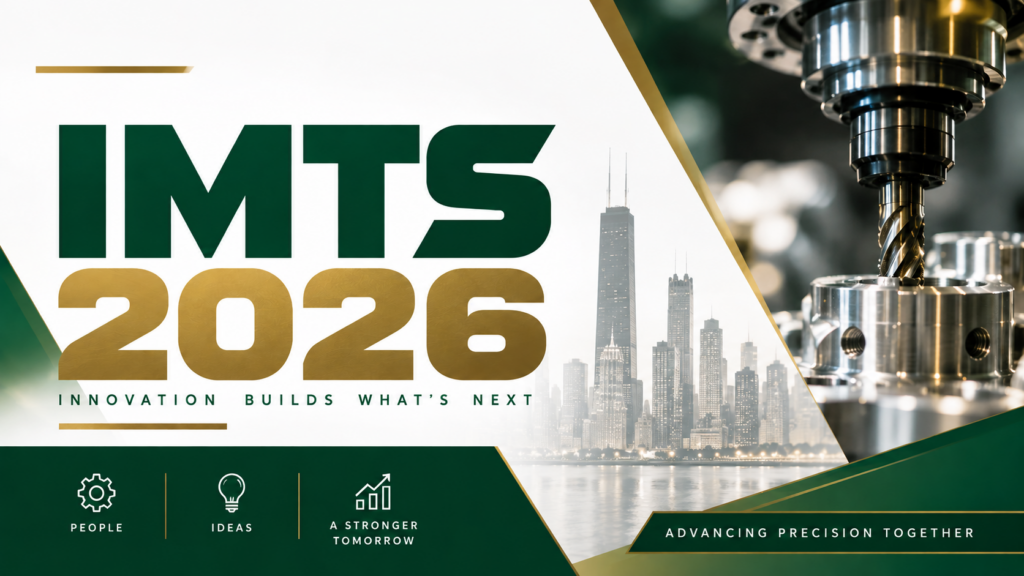
This week, roughly 90,000 manufacturing professionals and more than 2,000 exhibitors are moving through 1.2 million square feet of exhibit space at McCormick Place in Chicago for IMTS 2026 — the largest manufacturing technology show in the Western Hemisphere, running September 14 through 19. If you spend your days sourcing precision machined components rather than building the machines that make them, it’s easy to assume this week’s headlines are somebody else’s news. They’re not.
Every biennial edition of IMTS functions as a kind of industry weather report. The technology on the floor this year — industrial AI, adaptive automation, digital twins, and new multi-axis platforms — tells you where the machine shops feeding your supply chain are investing, and why. For a procurement lead, a quality engineer, or a sourcing manager evaluating a Swiss turning or CNC turning/milling partner, that’s not trade-show trivia. It’s a preview of who will actually be able to hold tolerance, hit dates, and scale with you over the next few years — and who won’t.
What’s Actually on the Show Floor This Week
A few themes are dominating IMTS 2026, and they line up closely with the capacity and workforce pressures we wrote about in our September post on aerospace and defense backlogs.
- Industrial AI has its own dedicated conference and exhibit area for the first time, with sessions focused on where AI genuinely improves machining, inspection, and planning — and where it’s still more buzzword than benefit.
- Automation and unattended operation are the through-line across almost every machine tool builder’s booth, aimed squarely at a documented U.S. manufacturing workforce gap that stood at roughly 495,000 open jobs as of January 2026.
- New 5-axis and multitasking platforms from major builders emphasize process consolidation — fewer setups, fewer handoffs, tighter control over tolerance stack-up on complex parts.
- Additive manufacturing is being positioned less as a novelty and more as a way to shorten supply chains for critical components, with new industrial-scale platforms launching specifically for aerospace and defense applications.
- Conference programming this year includes sessions from U.S. defense industrial base leadership, alongside domestic manufacturing growth and reshoring, underscoring how tightly national security policy and machine-shop investment decisions are now linked.
None of this is happening in a vacuum. U.S. manufacturing technology orders were up nearly 29% through the first four months of 2026 compared to the same period last year, and manufacturing labor productivity climbed even as hours worked stayed flat — a sign that the shops making these investments are already seeing them pay off.
Translating the Show Floor Into Procurement Terms
Trade-show technology only matters to a buyer if it changes what you can expect from a supplier. Here’s how the major IMTS 2026 themes translate.
Automation and unattended operation → lead time you can actually plan around
Shops running lights-out or unattended shifts aren’t doing it to look advanced — they’re doing it to keep utilization and output stable when the labor market won’t cooperate. For a buyer, that shows up as fewer surprise slips on release schedules, because your supplier’s capacity isn’t solely a function of who showed up for the second shift.
Industrial AI and adaptive control → consistency at tight tolerances
AI-driven vision systems and adaptive control are being marketed as tools that make automation accessible to a broader range of operator experience levels. Read past the marketing and the buyer-relevant point is this: process consistency becomes less dependent on any single machinist’s tenure. That matters directly for tight-tolerance work — the kind held to ±0.0002″ — where the difference between a good part and a scrapped one often comes down to repeatability, not raw skill.
Digital twins and connected shop floors → documentation and traceability
In aerospace, defense, and fluid control work, the part is only half the deliverable — the paper trail behind it is the other half. Digitally connected machining cells that tie process data to individual parts make first-article inspection, material traceability, and AS9100D documentation faster and more defensible, which is exactly what a quality engineer auditing a new supplier wants to see.
Reshoring momentum → confirmation, not a new argument
We’ve already covered why offshore sourcing has gotten harder to justify on landed cost alone. IMTS 2026’s conference programming — built around domestic manufacturing growth, defense industrial base investment, and supply chain localization — confirms that the reshoring conversation has moved from a hedge to a default assumption for buyers of mission-critical components.
Why This Matters More for High-Mix, Tight-Tolerance Turned Parts Than It Might Seem
A lot of the automation story at IMTS is framed around high-volume, single-part-number production — the kind of work suited to dedicated transfer lines and large robotic cells. That’s a smaller slice of the world for Tier 2 suppliers running Swiss CNC turning across brass, stainless, titanium, Inconel, and specialty polymers like PEEK for aerospace, defense, and instrumentation customers. The parts change. The lot sizes vary. The blanket order this quarter isn’t the blanket order next quarter.
The trends worth adopting from a show like this aren’t the flashiest ones — they’re the ones that hold up on a shop floor built around flexibility rather than volume: automation and tooling investments that shorten changeover between part numbers, process monitoring that catches drift before it becomes a nonconformance, and documentation systems that don’t add administrative burden to a shop already juggling dozens of active blanket orders. That’s the version of “IMTS technology” that actually shows up in your on-time delivery numbers.
What to Ask Your Machining Partner This Quarter
Whether or not anyone from your supplier’s team is walking the aisles at McCormick Place this week, IMTS 2026’s themes give you a useful checklist for your next supplier review or RFQ conversation:
- How is capacity actually being added — more headcount, more machines, or better utilization of existing equipment through automation and tooling investment?
- What does your process documentation and traceability look like for AS9100D or ITAR-relevant work, and how much of it is digitized versus manual?
- How dependent is part quality on a specific operator’s experience versus a controlled, repeatable process?
- Where is your material and component supply chain sourced, and how exposed is it to the same offshore cost and lead-time pressure driving the broader reshoring conversation?
- How do you handle flexible release schedules on blanket orders when demand shifts — is that a standard capability or a special accommodation?
These are the same questions the technology on the IMTS floor is trying to answer for machine shops. Asking them of your supplier just moves the conversation from equipment to outcomes — which is where it belongs.
Frequently Asked Questions
What is IMTS and why does it matter to buyers of machined parts?
IMTS — the International Manufacturing Technology Show — is the largest manufacturing technology trade show in the Western Hemisphere, held every two years in Chicago. It matters to buyers because the technology and investment trends showcased there — automation, industrial AI, digital process control — directly shape which suppliers can hold tolerance, meet delivery commitments, and scale reliably over the next production cycle.
Does more automation at a machine shop mean lower quality or less oversight?
Not when it’s implemented correctly. Automation and adaptive control are generally used to reduce variation caused by staffing changes or operator fatigue, not to remove oversight. The goal is a more repeatable process, with quality systems like AS9100D providing the documented control around it.
How does IMTS 2026 connect to reshoring and domestic sourcing decisions?
This year’s IMTS conference programming placed significant emphasis on domestic manufacturing growth and defense industrial base investment, reflecting federal policy support for reshoring alongside the cost and lead-time pressures already pushing buyers away from offshore sourcing of precision-machined components.
Is IMTS technology relevant to low-volume, high-mix Swiss turning work, or just high-volume production?
Much of the marketing focuses on high-volume automation, but the underlying principles — faster changeovers, better process monitoring, digitized documentation — apply directly to high-mix, tight-tolerance turned-parts production, where flexibility and consistency matter as much as raw throughput.
Fairchild Precision Parts has held AS9100D and ISO 9001:2015 certification while producing Swiss CNC turned and CNC turned/milled components to tolerances as tight as ±0.0002″ for aerospace, defense, fluid control, and instrumentation customers since 1944. If your current or prospective machining partner can’t answer the questions above with specifics, we’d welcome the conversation. Request a quote or talk to our team about a blanket order program built around your release schedule, not a machine shop’s convenience.